
Six Sigma Work for Your Business 2024, While most businesses are aware of the quality management system Six Sigma, not many are familiar with the intricacies of implementing a successful strategy. In fact, a lot of small businesses fail to see the benefit and end up wasting their time and money. But what are the common hurdles that prevent small businesses from achieving success? This article will help you overcome them.
Six Sigma is a set of techniques and tools for process improvement. It was introduced by American engineer Bill Smith while working at Motorola in 1986. A six sigma process is one in which 99.99966% of all opportunities to produce some feature of a part are statistically expected to be free of defects.
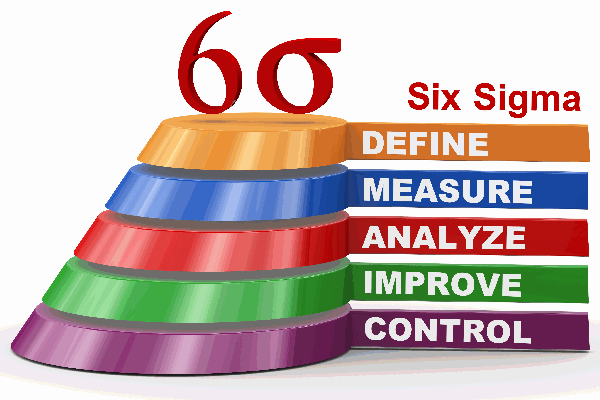
DEFINE -> MEASURE -> ANALYZE -> IMPROVE -> CONTROL
There are 5 methods in the Six Sigma method.
Define: Define the system, the voice of the customer and their requirements, and the project goals, specifically.
Measure: Key aspects of the current process are measured.
Analyse: Analysing to develop and design alternatively.
Improve: Identifying the potential and evaluation to improve the quality.
Control: Implement the process and developing control plans.
Read more: How To SEO Optimize Your Blog (Without Making It Boring)
The challenges of Six Sigma in small businesses:
In small businesses, it is challenging to implement Six Sigma because of the lack of resources. If the business is not well-established, it may be difficult to find the right people to implement Six Sigma. To overcome this challenge, it is important to have the support of the management and the board of directors.
Management’s opposition to adopting Six Sigma business management methods has been rooted in a fear of mission creep. Essentially, the management thinks that without strict promotion and training guidelines, employees will start applying such methods inconsistently. While this is a valid concern, it doesn’t solve the problem at its root. When employees are given authority to implement solutions, they will likely follow the guidelines to the letter.
To avoid having your business management methodologies trashed by micro-managers, it is important to have clear procedures and weekly reports showing the results. These reports should clearly show the action plan, how fully implemented the strategies are, and any successes so that the entire management team know what is being accomplished.
While you can devise your own training guidelines, there are several universal methods that can be helpful in increasing brand awareness, enhancing customer service, and ensuring high quality at the lowest possible cost.
The best way to improve brand awareness is through featured media like webinars, in-person workshops, and “meet and greet” events. Examples of marketing with featured media include:
Engaging with your audience on a first-name basis can generate brand awareness immediately. Foster relationships with employees through in-person events or virtual events.
Promote customer-centric solutions by developing comprehensive customer service policies that end-users are expected to enforce. Examples of policies are:
In short, a business that improves customer service consistently has the potential to improve every aspect of service delivery, including marketing, sales, customer service, financials, and more.
Six Sigma is mission driven and organizations that implement it apply the principles by following the ten principles of the Six Sigma system. These are the:
Six Sigma is distribution focused so the business uses data to prioritize projects and workers.
How to make Six Sigma work for your business..?
If you’re wondering how to make Six Sigma work for your business, the first step is to learn how to effectively implement Six Sigma into your business. Many businesses have struggled with implementing Six Sigma because they don’t properly understand how the methodology works. The second step is to decide if Six Sigma is right for you and your business. If you decide to implement Six Sigma as part of your monthly plan, take some time to familiarize yourself with the rest of the ideas covered in this article. Once you’re comfortable with what Six Sigma is and the steps it takes to create a successful campaign, take a look at the other important concepts that will help you succeed.
Implementation tips:
Step 1: Identify opportunities
Being aware that it’s time to start implementing the changes required to make your business run more efficiently typically means that you’ve already begun making the necessary changes to strengthen the business. It’s important to have a plan in place of where you want to go and what you plan to do before you start. By taking the time to identify your opportunities, you can focus your efforts in areas that will have the most impact.
The simplest way to identify opportunities is to stay in front of the mirror. Pay attention to how your customers speak to you, how they use your services, and how you feel when you think about your business. Pay special attention to these things because these behaviors will guide your strategy.
Step 2: Figure out the purpose
Once you’ve identified your opportunities and the specific activities that you need to prioritize, it’s time to figure out what the first step in your Six Sigma program is going to be. Your goal is to implement the changes you recommend within a set time-frame and to achieve your primary goals as a result. In order to hit your goals, you have to stick to your Six Sigma plan and make sure that it keeps your business running smoothly.
Two keys to a successful Six Sigma strategy:
To make your Six Sigma strategy successful, use these two keys:
1) measure improvement
2) identify root causes.
1) To improve, you need to measure improvement. You can identify problems in your business and fix them before they become big issues.
2) To identify root causes, you need to ask why. You can’t solve problems at their root. Problems become roots because they become so big that you can’t see them.
User experience gets presented to the user as a dialogue. A user comes in to submit an item for purchase. The user can ask questions in this dialogue–the purpose of which is to keep the user satisfied and add value to their experience. A great conversation can drive up sales, and conversion rates for marketing campaigns.
So, how do commercial stores and companies create great user experiences? What impact does great customer service have on sales?
User experience (UX) is based on the interaction the user has with a product or service. In simpler words, it’s the interactions with your product mapped to the user’s goals. For example, it’s user journey mapping, where you know the user is picking out their item, so you design the experience so that the item is delivered to them at the places that they’re looking. This helps the user get the right item, faster, and easier.
Customer service gets promoted as quality at a great price. This is because a lot of companies spend money on advertising, advertising that doesn’t get good customer service. Examples of bad customer service treatments are:
Advertising, whether it’s on TV, in magazines, or perhaps online, is very important for the survival of a business. The business is trying to reach their target audience, so they need to tell people what kind of services they have and what they offer. To get a high-quality list, a business will nab people’s attention by doing something different than the usual–they want to get a high-resolution picture of readers so they can read more.
How to implement quality management practices in your business..?
In order to implement quality management practices in your business, you need to identify and understand your process and what you’re trying to accomplish. Then, you need to find ways to make it more efficient. You need to find ways to improve it so you can deliver better quality products and services to your customers .And lastly, you need to identify what those things will cost, figure out what the ROI is, and determine how you’re going to measure it. Before you start a process that involves people, you need to ask yourself three questions.1. What is my goal?
How do you want to measure success? You have a goal for your business. Is it to produce a certain number of sales per month? Is it to create an organization that sets new standards in your industry or across the nation? Is it to keep more of your team or to replace your existing team members? Whatever your goal, it and is it specific? It is important to have clarity about what level of success you are targeting and what you expect to happen in order to achieve this goal. Asking these questions will help you create a strategy for growing and consolidating your targeted wholesale business.2. How do I know if I’m dealing with a good system?
Once you have identified your specific goal and the state of your current organization, stand back and assess if your current system is working the way you want it to. That’s it — this part is crucial.
When you have your goal, it is time to take a step back and look at the entire system. This is when you need to do a great deal of “homework.” If your current system is anything like most, it is a structure that does not funnel the right information to the right people. This can cause unnecessary expenses, confusion for the people in the organization, and short-term reach. Instead, use something that funnels all the right information in the proper places.